5 digital marketing trends for 2026
The podcast Tirgziņu Tērzes has established a tradition of meeting once a year with advertising and marketing agency WKND to discuss their annual marketing trends report. In this episode, WKND partner and strategist Edgars Pētersons joined podcast host Marija Vorkule to share the most notable marketing trends shaping the industry today. BSMS Head of Marketing Alīna Radzēviča also contributed her perspective on how these trends are playing out in practice across Latvia and the Baltic region.
The discussion explored the use of artificial intelligence in digital marketing, emerging export markets, the rise of Generative Engine Optimization (GEO), and the growing importance of fandoms and communities. If you do not have 40 minutes to listen to the full episode, here is a summary of the key takeaways.
Artificial intelligence in marketing: A tool, not a replacement
Over the past few years, artificial intelligence has become one of the central topics in digital marketing. It promises greater efficiency, faster execution, and lower costs, but the reality is more nuanced.
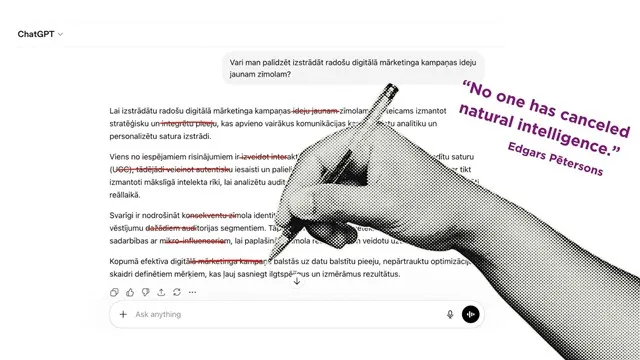
As WKND partner and strategist Edgars Pētersons pointed out during the podcast, the challenge lies not in the technology itself but in the quality of the output it generates. Today’s digital landscape is increasingly saturated with so-called “AI slop” — technically correct but creatively shallow content. The belief that AI can fully replace human creativity and experience often results in mediocre solutions and a loss of audience trust.
As Edgars explained, the situation is similar to how Photoshop was once perceived: the tool itself does not guarantee quality. Achieving exceptional results still requires expertise, time, and strategic thinking.
That does not mean AI lacks value — quite the opposite. Artificial intelligence is highly effective for data aggregation, market research, idea prototyping, content analysis, and automating routine tasks. According to Alīna Radzēviča, AI also has significant potential in lead generation and sales processes. For example, in cold outreach scenarios, AI can handle the initial interaction, assess customer interest, and only then transfer the conversation to a human representative.
When discussing AI-generated content on social media, the podcast participants agreed that it often creates a negative reaction among audiences. The widespread availability of AI tools enables virtually anyone to produce content, contributing to an overwhelming amount of low-quality material online.
“Today’s audiences increasingly value authenticity over perfectly polished studio content or AI-generated material,” says Alīna. As a result, there is growing demand for real people who make mistakes, show vulnerability, and are comfortable being imperfect.
_Z1Hkj2v.webp)
From SEO to GEO
One of the most significant digital marketing trends for 2026 is the shift from SEO to GEO.
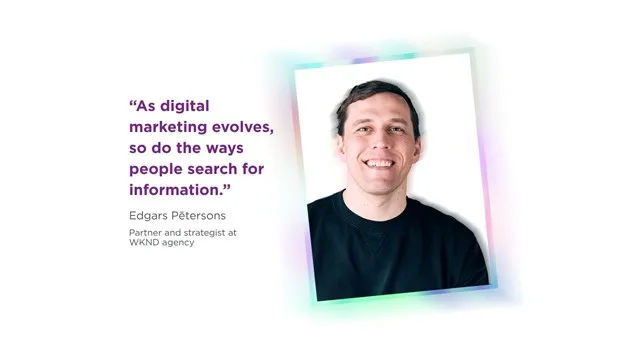
According to Edgars, digital marketing is evolving alongside the way people search for information. While Search Engine Optimization (SEO) has long dominated the field, more and more users are now turning to AI-powered platforms such as ChatGPT, Gemini, and similar tools to find answers. As a result, traditional SEO is being supplemented by a new approach: Generative Engine Optimization (GEO).
GEO focuses on how brands are represented within AI-generated responses. When users ask AI tools for product or service recommendations, businesses must consider how to become part of those conversations. This makes it increasingly important not only to optimize websites but also to establish a presence across the information sources from which AI models learn — including media outlets, forums, industry publications, and social media platforms.
Although GEO is still an emerging discipline with no universally accepted best practices, experts emphasize that companies should already be thinking about how their content is structured, where it is published, and in what context it appears. Just as SEO eventually became a specialized field requiring dedicated expertise, GEO is likely to evolve into a distinct marketing competency in the years ahead.
New markets beyond Europe and the United States
Another major marketing trend for 2026 affecting Latvian businesses is the shift in export priorities.
Traditionally, many Latvian companies followed a straightforward export strategy: first expand within Europe, then target the United States as the next major growth market. However, increasing geopolitical and economic uncertainty has prompted many businesses to reconsider this approach.
As Edgars highlighted during the discussion, companies are increasingly exploring new opportunities beyond traditional export destinations. India, South America, and the Middle East are frequently cited as promising regions due to their growing economies and expanding consumer markets.
At the same time, these markets are highly diverse, meaning a one-size-fits-all strategy is unlikely to succeed. Effective market entry requires a deep understanding of local culture, language, consumer behaviour, and the right business partnerships.
Interestingly, factors that are often perceived as burdensome within Europe - such as strict regulations and quality standards — can become competitive advantages abroad. In sectors such as food production and technology, the “Made in Europe” label can serve as a strong symbol of trust, safety, and reliability.
Fandoms and vibe marketing: The growing importance of communities
Another key digital marketing trend for 2026 is the increasing influence of fandoms and fan communities.
Social media platforms enable people to form strong emotional connections with musicians, films, television series, sports teams, and other cultural phenomena.
“This is exactly where brands are increasingly entering the conversation,” says Edgars. Instead of focusing solely on products, companies are seeking ways to become part of broader cultural discussions through collaborations, product placements, references, and shared aesthetics.
Although many fandoms are built around global cultural events, Latvian brands can also leverage these cultural touchpoints to communicate with audiences in ways that feel relevant and authentic. This approach is often referred to as “vibe marketing” - communication that relies on shared moods, aesthetics, and cultural context.
Edgars notes that audience segmentation based solely on age or gender is becoming less effective. Marketers increasingly need to understand which cultural movements people follow and which communities they belong to. The same cultural phenomenon can attract both a 15-year-old teenager and a 45-year-old professional.
In Latvia, this creates an additional consideration: highly niche audience segmentation is often not economically viable due to the country’s relatively small market size. Instead, brands may achieve better results by identifying broader cultural connections that resonate across multiple generations.
The changing aesthetics of digital marketing
A shift in aesthetics is also emerging as one of the defining marketing trends of 2026.
For several years, minimalism dominated both design and communication. This was reflected in brand identities as well as lifestyle trends such as the “clean girl” aesthetic and capsule wardrobes. Today, however, the pendulum appears to be swinging in the opposite direction.
As Edgars observed, the long-standing principle of “less is more” is increasingly being replaced by “more is more.” Across industries ranging from beauty and cosmetics to communication design, brands are embracing colour, playfulness, individuality, and more expressive visual languages.
This does not represent a rejection of quality or aesthetics. Rather, it signals a growing willingness to experiment. Brands are actively searching for new ways to differentiate themselves through originality, creativity, and distinctive identities.
What the 2026 marketing trends mean for businesses in Latvia
Digital marketing continues to evolve rapidly under the influence of technological innovation, cultural shifts, and changing audience behaviours.
Artificial intelligence, GEO, community-driven marketing, and emerging export markets are becoming increasingly influential factors shaping brand communication across Latvia and the Baltic region.
The companies that succeed will be those that can combine technological capabilities with authenticity, cultural understanding, and a genuine ability to build meaningful relationships with their audiences.
About the Tirgziņu Tērzes podcast
Tirgziņu Tērzes is a podcast created by the sales and marketing agency BSMS, focusing on current developments in marketing, communication, and business. Together with industry professionals, the podcast explores digital marketing trends, communication strategies, and market developments across the Baltics and beyond.
Listen to more episodes of Tirgziņu Tērzes at www.bsms.lv/podkasts.